By: Tomas Bernales-Jabur
For several years I had waited for the tenth-grade language exchange, knowing it was going to happen, yet avoiding the idea of it, telling myself it was still incredibly far away. That was, until the end of ninth grade, when I began to realize that I would not return to my class, my friends, my teachers, and my school life in New York, for nearly six months—half a year.
As the final date of my departure drew inexorably nearer, inevitably, expectations and nerves begin to build up. I expected to embarrass myself while speaking German, to botch some German social norms, or maybe not like my exchange partner. Some of these expectations happened and some of them did not, yet they all seemed to fade away when I finally met my exchange family in Munich.
Though we had spoken over Zoom, and texted, it was a remarkably different experience to meet the Trein family in person—meet the family that I would stay with for the next three months. Konstantin, my exchange, is the same age as me, and enjoyes watching plays, and dancing. His brother, Theo, is ten, the same age as my brother. Which, I must say, really helped the transition into their family life. The parents, Marcel and Kathrin are separated, and Marcel lives with his partner Rosa. She is from Barcelona.
Though the parents are separated, they live in the same home. A spacious two-story house on the outskirts of Munich. I had a room in the top floor, which was Kathrin’s space, while the boys alternated sleeping in Marcel’s apartment or Kathrin apartment. Because I had never experienced this way of living before, I was unsure of what to expect. However, the lack of awkwardness and the sense of family that they all shared was remarkable, and set me at ease the moment I opened the front gate into their home.
I arrived a week or so before the beginning of the school year, which gave me some time to adjust to German society and my new life. This week also gave me time to enjoy the city in what we thought would be one of the last warm weeks of the year. Konstantin and I took the opportunity to go for a swim, seeing as the weather was great. We biked to the center of the city, where we jumped into the river Isar. As I would find out later, this is one of the most popular past times for German teenagers.
One of the first things that I was told when I arrived in Munich was how the city was not really a city, but a large town. That first day while biking, Konstantin would greet people he knew. And though Munich is large geographically, the feeling really is of a town. The heart of the city, or the inner city is concentrated into the equivalent of downtown in New York, which made biking one of the main forms of transport.
While biking to the river I realized how law abiding the German people were. Firstly, they all stretch their arms out to whichever side they are turning when riding the bike. They also never cross on a red light. In fact, as my exchange progressed, whenever I walked through the city center, where one could find the highest concentration of tourists, the easiest way to differentiate tourist from local was to see who crossed on red lights.
Finally, my first day of school arrived, a moment that had played in my head as I tried to imagine what it would be like, the cultural gaffes I would perpetrate and the new people I would meet. The reality began when I woke up in the morning, incredibly tired and drowsy. I tried to down a cup of coffee, which I really do not like, but failed miserably, choking on the bitter brew. Konstantin and I then biked to the U-Bahn, or subway station, where we hopped on the U6, the train which would take me to school. It was a roughly 40 minute ride to Giselastraße where the Rudolf Steiner-Schule Schwabing was located. I was slightly overwhelmed as I strolled beside Konstantin into the bustling courtyard before the school.
Before I go on, however, it’s worth mentioning that the school is located in a traditional inner courtyard, or Innenhof. The school is hard to see for the passing pedestrians on the sidewalk, and one must enter into this Innenhof to reach the school. The courtyard was full of students, many arriving on bikes, or playing ping pong and basketball before the day began.
That was another aspect of the school which was interesting. Though the school had no sports teams, they had a large indoor gym, a full-sized outdoor basketball court, and several ping pong tables (Germans are very enthusiastic about ping pong).
The building itself was simple, with traditional Waldorf architecture where the corners are rounded off. The windows were interesting geometric shapes painted a light blue which instantly caught the eye of the viewer. Stepping into the building itself, the walls were plain and the school was sparsely furnished. Every classroom had a smart board with black board flaps over it that could be swung open to reveal the electronic board. My classroom was several floors up, and as we passed by teachers, they greeted Konstantin cheerfully, welcoming him back.
My first interaction with Konstantin’s classmates were merely one-word greetings like, “Hallo,” or “Wilkommen,” or other mumbled words that I did not catch. Since not much can be said from these first meetings I’ll reserve my descriptions of them for later. That first day we did not do much as it was only a half day, and we only needed to pick up our schedules, speak to the class advisors, and once that was done, we were on our way.
As the days and weeks progressed, I began to understand my classmates, teachers and the German Waldorf approach to education. My first impressions of everyone, teachers and students, were that they were lazy and not dedicated. That they did not really care about school and anything else for that matter. But after a while I realized that it was not that they did not care about school. The kids and teachers had other priorities, one of which was having a social life outside of school.
While at school, the main form of education was dictation. The teachers would dictate everything we had to write, from chemistry to math to German class. Personally, it was difficult. Once I finished writing a sentence, the teacher was five paragraphs ahead. So I resorted to copying from whoever sat next to me. In all honesty, school became mostly an annoying obligation, which I had to attend.
Where I really got to know my classmates was outside of school. At parties, or when we hung out at someone’s home. In that sense, the German parents are incredibly liberal minded. Allowing their kids freedoms that most teenagers in the United States can only imagine.
In any case, at the end of September came the largest party of all. The Oktoberfest, a traditional festival where, essentially, the people of Munich come together to drink a lot of beer. They dress up in traditional garments and gather in the tents. The tents are owned by the breweries like Paulaner, or Löwen-Bräu, Hacker-Pschorr, and others.
Unfortunately, this celebration, which the Germans observe in a semi-religious manner, has become an incredibly touristic activity. My first day at the Wiesn, which is the festival grounds for the Oktoberfest, Marcel said that the people who had all the parts of a traditional Oktoberfest garment were probably tourists. Most Munich people would only where the basic lederhosen with a nice shirt and sneakers.
Another thing that I found interesting was that everyone came, kids and adults. There were several amusement rides built, which little kids, and adults enjoyed tremendously. As one walked through the rides and the many tents, the wiesn reverberated with the excited shrieks of the people enjoying Oktoberfest, as the rides spun over your head.
Konstantin and I entered the tents a few times, which was nice as it is incredibly hard to get in and reserve a table. We went once with the kids in his class and it is indeed an amazing experience. Everyone, half-drunk, was singing and drinking beer, and the atmosphere was eye-opening. It is an inexplicable feeling, one that gave me goosebumps, listening to the tents reverberating with the voices of hundreds of people singing songs like “Sweet Caroline.”
Once the Oktoberfest was over, Konstantin’s classmates settled back into their normal routine. And because Konstantin began to have extracurricular activities like theater and tennis, I went about life on my own. Several times, me and some of the more rambunctious kids in the class went to the park and had a bonfire their relaxing well into the evening. But as the cold days came, we began to move these gatherings indoors.
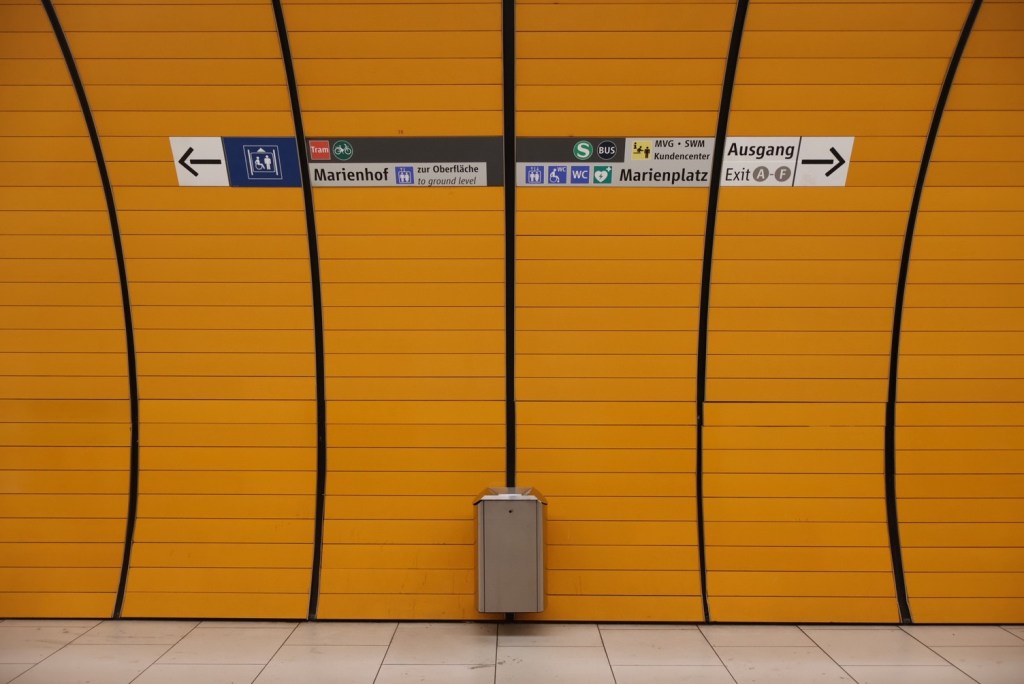
One thing that surprised me was how safe it was to move around at two in the morning in Munich. As a joke, I sent a picture of the subway at two in morning to my mom, asking her what time she thought it was. She answered that it was seven in the morning. The subway was so clean and well-lit that she could not tell the difference.
Though by the halfway mark of my exchange, my German speaking skills had improved drastically, I still had some communication hiccups. One which was quite hilarious—though I must say that I did not think so at the time—was when I was speaking to the German teacher. She spoke in a harsh yet poetic manner, with a strong southern German accent which made it ten times harder to understand. I had just finished class and she was asking me how my exchange was going so far. Unfortunately, much to my chagrin, I understood her to say if I enjoyed my exchange so far, to which I answered yes. But in the context of what she was really asking, yes was an absurd answer, and we remained in this awkward deadlock until Konstantin explained what had happened.
Around the end of October the school had and autumn break, which I enjoyed tremendously. Konstantin’s mother took the opportunity to take me, Konstantin, Theo, and his friend, Noah, to the north of Germany, near the Danish border. We stayed at a farm which had several rooms for people passing by. A popular way of making money for smaller farms in Germany. Because we were near the ocean, we went for a swim one day. The water was around 7 degrees Celsius, the temperature outside was the same, and the wind at 17 miles per hour made it so much colder. Though I went in for a mere minute or so, by the time I ran back to the relative warmth of a towel, my legs were numb from the cold.
The following day was Halloween, which, surprisingly, is celebrated by the Germans. We went to a Halloween party in Hamburg, and before leaving had a small bonfire with Konstantin’s extended family, who were also staying at the farm. This was one of the few times that I missed New York, seeing the pictures of my brother in his Halloween costume and my friends telling me how their own Halloween festivities were going. After the week was over, we returned to Munich, where school began again.
Slowly my exchange came to an end, and as my departure date approached a feeling of melancholy seemed to swoop in. One of the last nights, I gazed up at the sky, which was bright with stars, something that I never see in New York, and it hit me how much I would miss Germany when I returned to New York. I thought back to the friends I had made, and the daily habits that I had formed in Germany. I also thought about how I had taken the opportunity to be someone different than I was in New York. Though it felt nice to be returning back to my family, my friends, and to New York, which is my home, I was also sad to be leaving the place that had taken me in for the last three months.



 15 East